Natural materials do not need to match perfectly to belong together. A room often feels more convincing when surfaces have distinct roles: a durable floor, a forgiving fabric, a smooth handle and a little contrast where the eye needs an anchor. Start with those roles before assembling a colour palette.
Begin with the fixed surfaces
Flooring, kitchen fronts, window frames and a large existing sofa usually have more influence than a new cushion. Identify their undertones before choosing paint. An apparently neutral grey may lean green, violet or warm brown when placed beside timber. A creamy white can make another pale surface seem unexpectedly pink.
Test generous samples vertically and horizontally, because light reaches those planes differently. Revisit them in daylight and with your evening lamps switched on. A sample viewed only under a shop’s lighting may give a misleading impression of your home. Do not decide from a screen alone; display settings and photography can alter colour substantially.
Use contrast to keep neutrals alive
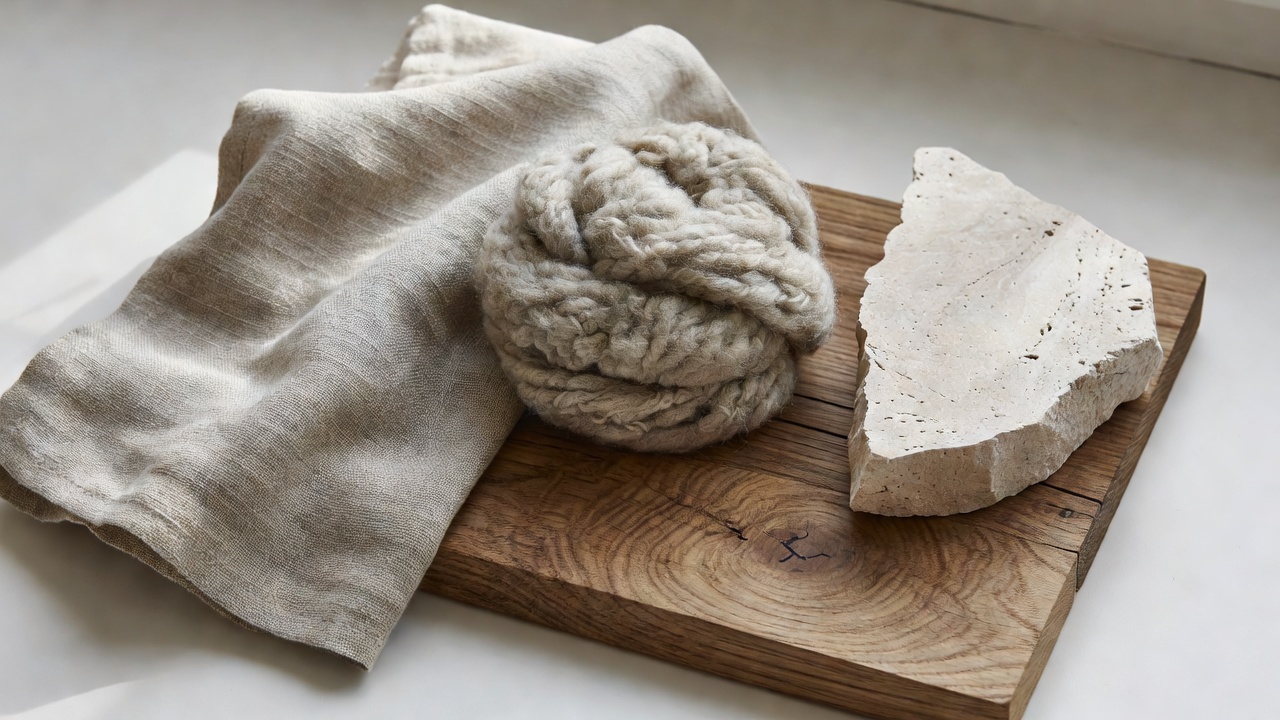
A warm neutral room benefits from differences in value and texture. Pale linen against a pale wall can be beautiful, but a darker timber edge or rust-coloured ceramic gives the eye something to register. Repeat an accent sparingly so it feels connected rather than scattered.
Try pairing one clearly grained timber with quieter surrounding surfaces. Several bold grains, busy stone veins and heavily textured fabrics can compete even when their colours are similar. Conversely, a room made entirely of smooth, closely matched finishes may feel flat. Balance is about the intensity of each surface, not a fixed number of materials.
| Material | Useful quality | Practical check |
|---|---|---|
| Linen | Relaxed texture and soft drape | Care label, lining and tolerance for creasing |
| Wool | Tactile warmth and resilient fibres | Cleaning method, shedding and household sensitivities |
| Timber | Visible grain and potential repairability | Solid or veneered construction, finish and water exposure |
| Natural stone | Variation and a substantial surface | Porosity, acid sensitivity, sealing and structural weight |
Choose timber by construction and finish
Oak, ash, birch and pine have different appearances, but species alone does not tell you how an object will perform. Ask whether a panel is solid timber, veneer over a stable substrate or a decorative imitation. Well-made veneer can use material efficiently and perform reliably; solid wood is not automatically the best option for every component.
Oiled and lacquered finishes also behave differently. Some oil finishes can be refreshed locally, while certain film finishes offer greater resistance to everyday marks. Actual performance depends on the product and application. Ask for care instructions and a demonstration sample, particularly for dining tables, bathroom joinery and kitchen surfaces.
Let textiles suit the household
Linen curtains can filter daylight without making a window feel heavy, but an open weave may provide little privacy after dark. Check the fabric against a light source and consider whether lining or a separate blind is needed. For seating, evaluate abrasion information alongside comfort, construction and cleaning requirements rather than relying on a single durability claim.
Wool rugs can soften footsteps and make a seating area feel grounded. They also need suitable underlay and an edge placement that does not create a trip hazard. If allergies or sensitivities matter in your household, request samples and specialist guidance where appropriate. “Natural” does not mean universally comfortable, non-allergenic or maintenance-free.
Be precise about environmental claims
Keeping a sound existing piece may be a more useful starting point than buying a new object marketed as sustainable. Consider repairability, transport, expected service life and whether replacement parts are available. Ask what a claim covers: the raw material, the manufacturing process or the complete product.
The Forest Stewardship Council, PEFC and Nordic Swan Ecolabel provide different certification frameworks. A logo is not a substitute for checking the specific product and certification scope. No single label answers every question about durability, emissions, labour or suitability for your room.
Use references as a way to notice
The interiors of Aalto House in Helsinki, Villa Mairea in Noormarkku and Finn Juhl’s House in Ordrup offer useful opportunities to observe relationships between timber, textiles, art and daylight. They are distinct places with distinct histories, not a single Nordic formula. The Alvar Aalto Foundation and Ordrupgaard provide context for exploring these references.
For an achievable first step, gather three samples: one surface you are keeping, one proposed textile and one paint colour. Live with them in the actual room for several days. Remove the sample that creates tension, rather than adding more choices to compensate. A limited, well-tested palette gives texture room to speak.